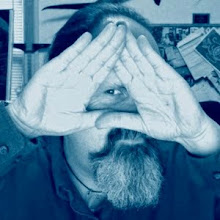
Jacobi, THIS IS ART, 2005 (digital comp for finished art, 30” x 30”, acrylic on plywood)
“Anything can be art.” Most anyone involved or interested in art has heard someone make this statement. But is it true? If this statement is true, then anyone can be an artist simply be declaring him/herself to be one. If that is the case, then the concept of being an "artist" becomes meaningless.
In what other line of work can a person "be" something, just by declaring so? Consider the following:
I am an artist, because I say so.
I am a plumber, because I say so.
I am an airline pilot, because I say so.
I am a surgeon, because I say so.
The piece above, THIS IS ART, is an assemblage I did in my final class in my course of studies for my masters degree in art education. It was really a follow-up to the course I had taken in the previous semester called “Art Trends and Art Education”, which had a focus on installation art and postmodern art in general. As someone coming out of twenty years as an illustrator, and moving into the area of teaching high school art classes (drawing and painting, not commercial art), I found myself thrust into an ongoing dialog with my classmates, my professor, and ultimately myself as to what kind of understanding I would have of the contemporary art world of today. The following is an excerpt from an “academic journal” I kept for the Art Trends class:
I would like to make a few comments on installation art and postmodern art in general. It seems to me that much of this work has its origins in Dada and in Duchamp’s “ready-mades”. Dada was, in large part, a response to the horrors of World War I. Disillusioned and disgusted by what the world had come to, Duchamp and the other artists of the Dada movement turned
 their backs on the traditions and values of Western culture and bourgeois society. Embracing a nihilistic position, they created an irrational art that defied understanding, and ultimately defied the traditions of Western culture itself. Although this work, indeed much of modernism in general, was embraced by what Tom Wolfe in his book The Painted Word calls the “culturati”, the public has in large part rejected it. Oliviera et al quote Guillaume Apollinaire as suggesting (in 1913) that Duchamp would perhaps be able to “reconcile art and the people” (p.11). I maintain that this has not come to pass. As I suggested in my presentation of this material to the class a few weeks ago, it seems to me that what we now have is a new elite made up of artists and art critics, existing in their own isolated world, apart from “the people”, who are for the most part confounded and sometimes even angered by much of the art that is currently being championed by the art intelligentsia (Wolfe’s “culturati”).
The progeny of Dada, postmodern art to a large extent continues Dada’s tradition of nihilism and the rejection of the traditions and values of Western civilization. Everything that was good is now bad. Everything that was bad is now good. How else can we explain the promotion and admiration (by the “culturati”, not by the general public of course; who cares about them- the “ignorant unwashed”) of “art” that features masturbation and autosodomy?
In the introduction to an interview with Donald Kuspit, author of The End of Art, Emmit Cole states:
 “Typical postart [more or less Kuspit’s term for postmodern art] values include: a tendency to mock posterity, a tendency to elevate the banal to the status of the enigmatic and the scatological to the status of the sacred, and a preference for concept-driven art. Postart is art at the service of the mind and the product of joyless, “clever, clever” theorizing. Entertainment value and commercial panache are valued more highly than artistic ability or aesthetic worth and painting is perilously close to becoming a sub-genre of performance art.” (2004)
I have never been much of a fan of installation art, performance art, or conceptual art in general. This is not to say that I am a strict disciple of Formalism; I love a good idea or concept in a piece of art as much as anyone, but I prefer art that combines concept, design, and skill or technique. A work of art that shows a high degree of skill but has no idea or theme behind it would seem to be missing something; likewise, art that is strictly idea-based with no demonstration of skill and little or no concern for the art object is of very little interest to me.
*****

Hirst, The Physical Impossibility of Death in the Mind of Someone Living, 2005
Shortly after writing the above journal entry, I came to a realization that the term “postmodern art” actually covered a pretty wide range of art; no surprise really, the same could be said of “modern art” as well. Ultimately, we would really have to define postmodern art as any art since the end of the modern era (around 1970). On one hand, postmodern art would include conceptual artists like Damien Hirst, whose works include dead animals and cigarette butts, or Andres Serrano who utilizes blood, semen and urine (as seen in the photograph Piss Christ).  However, it would also include the highly skilled work of “New Old Masters” (the term coined by art critic Donald Kuspit) such as Odd Nerdrum and Vincent Desiderio. We should also include the art that is sometimes described as “Contemporary Pop” or “Lowbrow”, as seen in Juxtapoz magazine, which at the time of my journal entry was outselling Art in America.
As things stand right now in the art world, there is basically NO consensus as to what is good or bad art, or even to what art actually is. I find it to be frustrating, maddening, and exciting, all at the same time. “Nothing is forbidden, everything is permitted.” -- Hassan-i-Sabbah

Nerdrum, Return of the Sun, 1986

Baseman, Piñata, 2000
 However, it would also include the highly skilled work of “New Old Masters” (the term coined by art critic Donald Kuspit) such as Odd Nerdrum and Vincent Desiderio. We should also include the art that is sometimes described as “Contemporary Pop” or “Lowbrow”, as seen in Juxtapoz magazine, which at the time of my journal entry was outselling Art in America.
As things stand right now in the art world, there is basically NO consensus as to what is good or bad art, or even to what art actually is. I find it to be frustrating, maddening, and exciting, all at the same time. “Nothing is forbidden, everything is permitted.” -- Hassan-i-Sabbah

Nerdrum, Return of the Sun, 1986

Baseman, Piñata, 2000
Sources for the excerpt from my academic journal:
Cole, E. (2004). Book review: The end of art, by Donald Kuspit. Retrieved December 9, 2004 from http://www.themodernword.com/reviews/kuspit.html
De Oliveira, N. (1996), Installation Art, London: Thames & Hudson Ltd.
Wolfe, T. (1975). The painted word. New York: Farrar.

Robert Williams, In the Pavillion of the Red Clown, 2005